Pinterest for Amazon Influencers: How to Get Passive Clicks and Commissions Without Making More Videos
If you’re an Amazon Influencer, you already know the grind.
You film the video. You edit it. You upload it. You wait to see if it gets placed on a video carousel. And then, if you’re lucky, it drives commissions for a few weeks or months before it fades into the background and you have to start all over again.
It’s exhausting — and it’s not sustainable.
What most Amazon Influencers don’t realize is that there’s a platform quietly sending traffic to storefronts and product links 24 hours a day, 7 days a week, long after the content was created. A platform where you don’t need a following to get discovered, where you don’t have to show your face, and where content from two years ago can still drive clicks today.
That platform is Pinterest.
And before you scroll past thinking “Pinterest isn’t for me” — keep reading, because what Pinterest actually is in 2026 might surprise you.

Pinterest Isn’t Social Media. It’s a Search Engine.
This is the most important thing to understand, and it’s the reason most creators completely underestimate it.
When someone opens Instagram or TikTok, they’re looking to be entertained. They’re in browsing mode. Buying something is the last thing on their mind.
When someone opens Pinterest, they’re searching for something specific. They type in “Amazon home organization under $50” or “best gifts for new moms” or “cozy living room finds” — and they’re already in a buying mindset. They’re planning, researching, and looking for exactly what you’re already recommending on Amazon.
Pinterest has over 619 million monthly active users, and 93% of them say they use the platform to plan purchases. 85% of weekly users have made a purchase based on something they saw on Pinterest.
These are not people scrolling for entertainment. These are buyers — and they’re actively looking for pins that lead them to products.
How Pinterest and Your Amazon Links Work Together
Here’s the simple version of how this works:
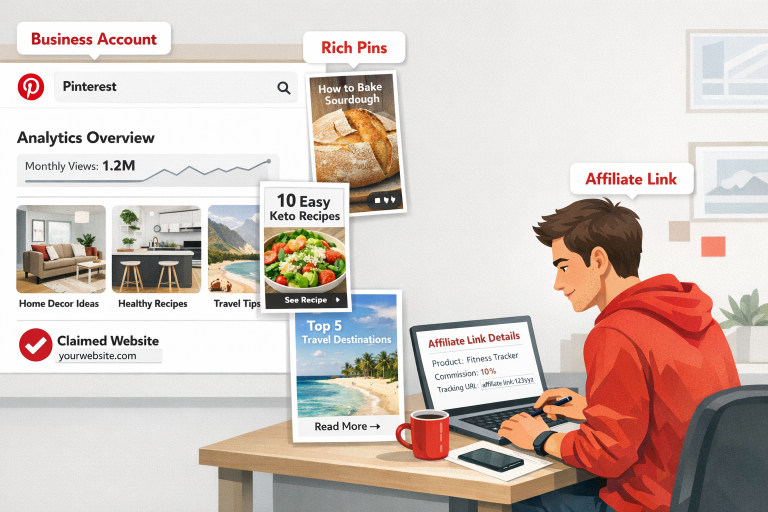
You create a Pinterest pin — a vertical image with a text overlay and a keyword-rich description — and you link it directly to your Amazon storefront, a specific product page, or a blog post that promotes your Amazon picks.
When someone on Pinterest searches a relevant keyword, your pin gets served to them. If it’s well-optimized and visually appealing, they click. They land on your storefront or product page. They buy. You earn a commission.
The key difference from video content? That pin keeps working. Pinterest content is evergreen. A pin you create today can rank in Pinterest search results for months — sometimes years — and drive traffic to your links the entire time without you lifting a finger.
No re-filming. No re-editing. No chasing trends.
What the Pinterest Algorithm Actually Rewards in 2026
Pinterest’s algorithm has gotten smarter, and understanding how it works is what separates creators who get results from those who feel like they’re shouting into the void.
There are four things Pinterest cares about most:
Keyword relevance. Pinterest reads your pin title, description, board name, and board description to understand what your content is about and who should see it. This means every pin needs a keyword-rich title (50–100 characters) and a detailed description (100–200 words) written in natural language. Think about exactly what your ideal buyer would type into Pinterest search.
Engagement signals. The most powerful signal Pinterest measures is saves — when someone saves your pin to their board, Pinterest takes that as a strong endorsement and shows it to more people. Close-ups (when someone taps to expand your pin) are also a major signal in 2026, so your image and text overlay need to create genuine curiosity.
Visual quality. Pinterest is a visual platform, and the algorithm rewards pins that stop the scroll. Your images should be 1000×1500px (2:3 ratio), sharp, and high-contrast. Text overlays should be readable on a small phone screen without zooming in.
Fresh content consistency. Pinning 3–5 high-quality pins per day consistently outperforms sporadic mass-uploading. The algorithm tests each new pin with a small audience first — if it performs well in the first 48–72 hours, it gets shown to more people. Quality and consistency beat quantity every time.
A Real Example of What This Looks Like
Let’s say you’re an Amazon Influencer who reviews kitchen products.
You create a pin with a clean image of a popular kitchen gadget, a text overlay that says something like “amazon kitchen finds that actually live up to the hype”, and a description that includes keywords like “Amazon kitchen gadgets,” “best kitchen finds,” and “kitchen products under $50.”
You link that pin to your Amazon storefront or a curated idea list.
Someone searching “best kitchen gadgets Amazon” finds your pin. They click. They browse your storefront. They buy three things. You earn a commission — from a pin you made once, that has been sitting there working for you.
Now multiply that by 20 pins. By 50 pins. By six months of consistent pinning.
That’s what passive income from Pinterest actually looks like.
The Mistakes Most Amazon Influencers Make on Pinterest
If you’ve tried Pinterest before and didn’t see results, it’s almost certainly because of one of these:
No keywords in the description. Leaving descriptions blank (or writing one vague sentence) means Pinterest has no idea who to show your pin to. Descriptions are your SEO — don’t skip them.
Horizontal or square images. Pinterest is built for vertical content. Square images get cropped awkwardly on mobile and significantly underperform. Stick to 2:3 ratio, every time.
Linking to your homepage instead of a specific destination. If your pin promises “cozy home finds” but takes people to your general website homepage, they leave immediately. Always link to the most relevant, specific destination you can.
Pinning randomly without a strategy. Pinterest rewards consistency and relevance. Random pins across unrelated topics confuse the algorithm about what your account is actually about — and hurt your reach across the board.
Expecting fast results. Pinterest is a long game. Most accounts start gaining real traction around the 3–6 month mark of consistent effort. The creators who quit at month two never get to see the compound effect that makes it worth it.
You Don’t Have to Figure This Out Alone
If you’re reading this thinking “this makes sense, but I have no idea where to actually start” — that’s exactly why I built Pinterest for Influencers.
It’s a course specifically designed for Amazon Influencers who want to use Pinterest strategically to drive passive traffic to their storefronts and links. Not a generic Pinterest course. Not a blogging course with a Pinterest section. A course built specifically around how Amazon Influencers can make Pinterest work for the content they’re already creating.
Inside, you’ll find step-by-step video modules, a keyword bank to take the guesswork out of optimization, plug-and-play pin templates, an AI prompt bank for creating scroll-stopping visuals, and a platform comparison guide so you know exactly where to focus your energy.
The goal isn’t to replace your video content. It’s to build a traffic channel that works while you’re not.
Ready to Let Pinterest Do the Heavy Lifting?
If you’ve been stuck on the content treadmill — filming, posting, hoping for clicks — Pinterest might be the thing that finally lets you step off it.
The Amazon Influencers who are quietly building passive income streams right now aren’t working harder. They’re just adding one strategic layer to what they’re already doing.
🎯 Join Pinterest for Influencers
Everything you need to start driving passive traffic to your Amazon links with Pinterest.
✔ Step-by-step video modules
✔ Keyword bank & pin templates
✔ AI prompt bank for pin creation
✔ Platform comparison guide
✔ Quick start guide
Enroll Now → http://www.kindlyconnected.com/pinterest
You don’t need to go viral. You just need to get found.